DesiBlitz Interview 11th August 2025
I’m pleased to be interviewed for my new novel, RING TWICE for MRS NAREN.
The link. https://www.desiblitz.com/content/vijay-medtia-on-love-crime-delhi-in-ring-twice-for-mrs-naren
My interview in South India blog, April 2024.
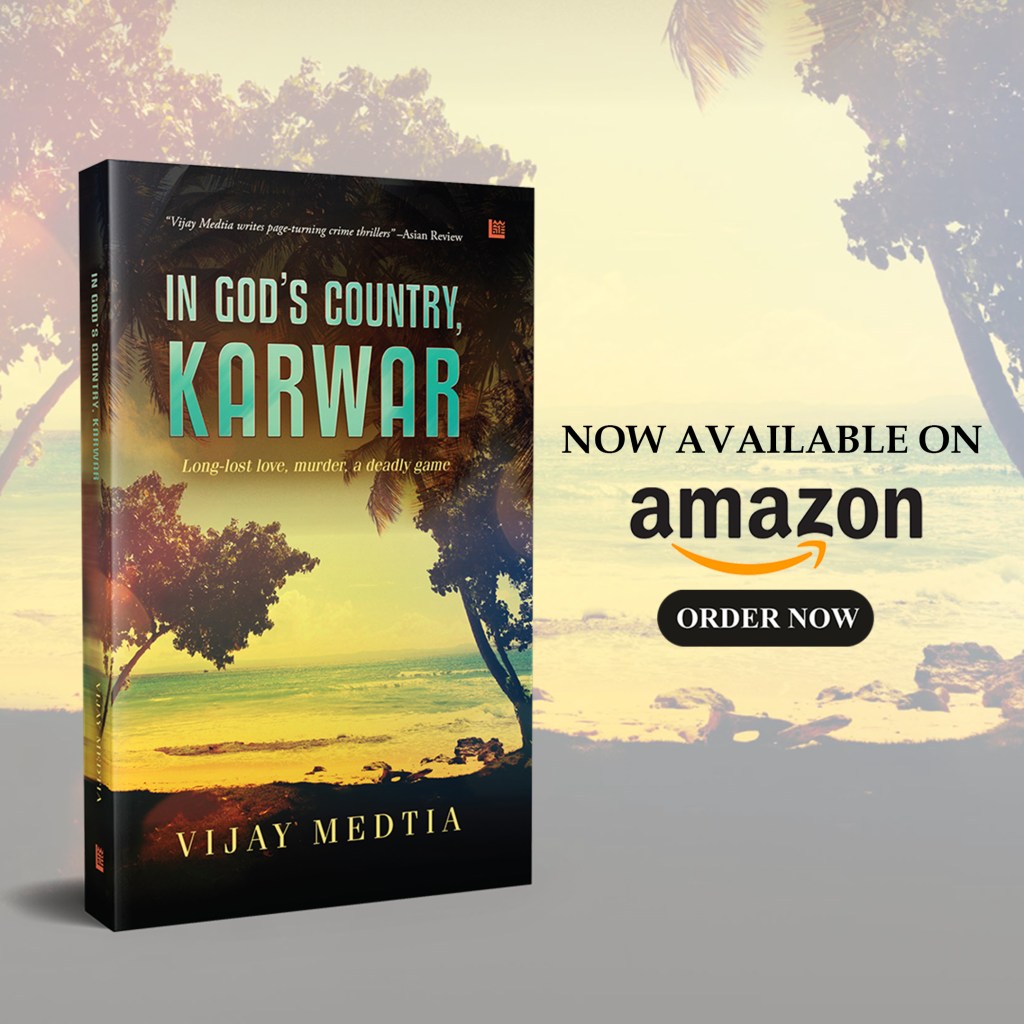
Extracts from IN GOD’S COUNTRY, KARWAR.
HE told his wife a lie. There was nothing unusual about this for Satish Verma lied often. He usually said he was working late and that he might spend the night at the office. Her reaction was the same, an indifference, a lack of care. The marriage had failed in so many ways, and after nearly twenty years, it was time to make a clean break. He drove out of Karwar and headed north towards Goa. The journey would take over an hour, but he was looking forward to meeting the other woman.
THE Ocean sound is what you hear first, loud all-encompassing waves rolling in from the Arabian Sea. The wind blows and sways the palm trees on the beach, broad leaves rustling to a peaceful rhythm. Birds flock and fight, each one more exotic than the next. Fishermen throw nets from colourful wooden boats. The perfect idle however was brutally disturbed. Life has the cruel capacity to cause pain when least expected.
Tell us about your new crime novel, In God’s Country, Karwar, and what inspired you to write it?
The novel is a story of long-lost love, friendship and murder set in the scenic coastal town of Karwar, India. The place is close to Goa, with which readers are more familiar. This is my fourth novel, and my last few were set in Mumbai. When I started to write this novel, I wanted a new setting and location for my story, and I found Karwar to be the perfect setting; a scenic, coastal town facing the Arabian Sea. It would contrast against the murders that take place there.
Inspector Rock of the Karwar Police investigates the unexpected murders without apparent motive. Running parallel to the investigation will be a love story and how that impacts the story. The main inspiration however for the story were the central characters that formed in my mind, and the location worked as a compliment to the novel.
What is your novel writing process? How long did it take to write the novel? What keeps you motivated throughout?
Every writer has their own writing process. It’s not a formula, and that’s part of the fascination for readers, i.e., how do writers produce novels? I write the first draft by pen and paper. I have always done it this way and it has become my ritual you can say. I prefer the natural flow onto the paper without the laptop constantly interfering with spelling and grammar checks at this early stage. Hemingway and other great writers wrote with pen and paper, and if it was good enough for them, it’s good enough for me. After a second draft, I type onto the laptop and start to edit. This can take several rounds. It’s good for a writer to learn how to edit. There are many tips on the net. A good tip is, ‘less is more.Avoid adjectives and adverbs if possible.’
This novel took the best part of a year to write, trying to find time between work/life commitments. Don’t let anyone tell you writing is easy!
Regards motivation to keep writing, that’s a tough question. You try to do your best and don’t worry too much if the novel will be published or not. I have several unpublished novels.Try to stay in the present and do the best you can. Keep writing regularly, and read other good novelists. If the story is working then that will keep you motivated. If the story is dragging, you need to look at it and change it perhaps.
You explore many themes in your novel, friendship, love and of course the investigation of murders. What did you want your readers to understand through your observations?
Yes, it’s a crime story first and foremost, but I wanted to explore love and friendship. It was a new challenge and I wanted to see how the characters responded to sudden loss, how they coped with the inevitable grieving process, how did they overcome the great challenges. The characters often surprised me. You plan to write one chapter and the character steps in and writes another. The magic of writing always surprises me, and I often wonder who is actually writing the story.
The readers are intelligent enough, my first aim however is for them to enjoy the story, to be entertained, my novels contain humour and intrigue hopefully. I am also showing a mirror to society and I try not to make judgements. That I leave for the readers.
What is your experience of getting published in Mumbai, India?
Very good and positive. My first two novels, The House of Subadar, and The Missing Husband, were published by UK Publishers.
My third novel, The Lost Woman of Santacruz and my new novel, In God’s Country, Karwar are published in India by my publisher Leadstart. They have worked well with me and have good bookstore distribution in India. The novel received good reviews and media coverage. And we are hoping the same again and more. India is a huge market and my books are gaining attention there. This is something others writers should consider, you don’t have to just submit to UK agents and publishers.
My last novel, The Lost Woman of Santacruz, which introduced Inspector Ajay Shaktawat, has interest from an Indian Film and tv production house, to turn the novel into a film or a ten-part crime drama for OTT platforms. So, this is an exciting development for any writer as you can imagine.
What advice would you give to anyone who is working on their first novel?
- Finish the first draft, good or bad.
- Try not to re-write before finishing the first draft.
- Read good writers in your chosen genre and beyond.
- Learn how to edit.
- Don’t quit your day job, you will need the money to write.
- Write some short stories.
Good luck.
Vijay Medtia is a novelist and short story writer, based in the UK. He visits India regularly for his inspiration. In God’s Country, Karwar, is his fourth novel. His debut novel, The House of Subadar, was published by Arcadia Books, UK in 2007. It was short-listed for the Glenn Dimplex, Literary Prize, Dublin 2008. He has had several short stories published in the UK and India. His recent short story, ‘Master Chef,’ was published by the Singapore based literary magazine Kitaab.org in July 2023. His second novel, The Missing Husband, was published by Crocus Books, UK, 2019 and received good reviews.
His third novel was The Lost Woman of Santacruz, published by Leadstart, India, 2021. Again, it received good reviews from readers and the media. There is interestfrom a TV and film production house in India, to turn The Lost Woman of Santacruz into a film or a ten-part crime drama.
He likes the quote, ‘There is nothing impossible for him who will try,’ by Alexander the Great.
IN GOD’S COUNTRY, KARWAR was published October, 2023. Book available as a paperback and ebook via amazon.
Website- vijaymedtia.com
Author Interview – Vijay Medtia of “The Lost Woman Of Santacruz”
Sarath Babu blog August, 2021.
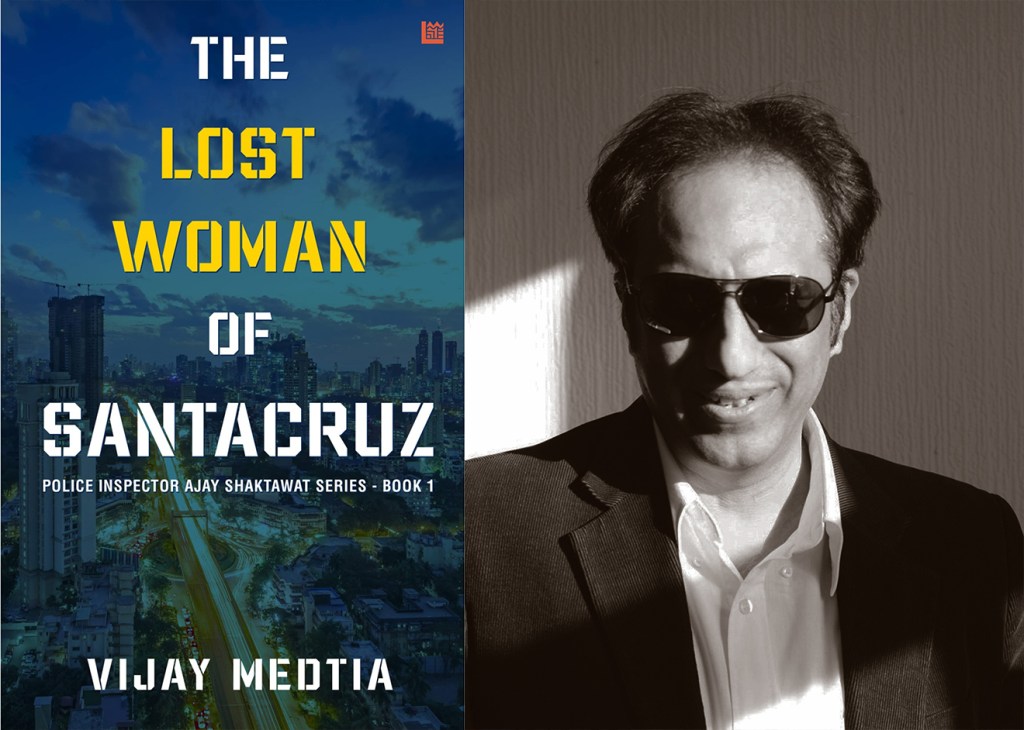
About the Author: Vijay Medtia
I am a short story writer and novelist. My debut novel, The House of Subadar was published by Arcadia Books, London. It was short-listed for the Glenn Dimplex Literary prize for new writers in Dublin, 2007.
I have had several short stories appear in anthologies; Leaving the Reno, in the Moss side collection by Crocus Books. English Babu, in the Migration anthology in association with the University of Lancaster.
English Babu was set as an exam question for secondary pupils in Denmark.
Haram and British Guide, were published in Indian e-literary magazines.
My crime novel THE MISSING HUSBAND, was published in 2019 by Crocus Books and I was invited to read at the Manchester Book Festival. I was also invited to a University in Poland to read from my novel.
My new novel THE LOST WOMAN OF SANTACRUZ will be published by leading Indian Publishing House Leadstart in June 2021.
I am a British Indian writer based in the northwest, U.K.
1. What motivates you to write?
I wish to tell stories in my voice, style and vision. Every writer has their unique way of sharing their stories and I wanted to do the same. This realisation came later, initially it was just about writing a good story and that also still holds true today.
2. How did you feel after publishing your books?
Very good and happy. It’s a special feeling to see all your hard work put into a small paperback. It’s hard to describe the feeling.
3. What are some of your favourite novels and authors?
All the great writers from the past. From India, I like RK Narayan, VS Naipaul.
4. Is there a specific reason for naming your novel?
Yes, the novel is set in the district of Santacruz, Mumbai.
5. Where do you write from? Do you go to some specific place, like beachside or the hills?
My best writing place is the library, has been for years. There are great libraries in England, where you can write in peace and quiet. And on the days where the writing is hard going, you can just go and pick up a good novel to read instead.
6. What was your biggest learning experience throughout the writing process?
Writing is a lonely business; you have to have the ability to write alone for months and years at a time. Many people have talent but you also need discipline and perseverance. You have to read good novels, be open to learning from other writers. You also have to learn to edit.
7. Looking back, what did you do right that helped you break in as a writer?
As simple as it sounds, writing a good, intriguing story. Followed closely by learning to write properly. This part takes years and isn’t so simple. To learn the craft of writing takes years and I’m still learning.
8. Any best piece of writing advice that you would like to share with new or struggling writers?
Follow your dream and don’t quit. Perseverance is key, along with being sharp and learning quickly about the craft of writing. You can find many tips on how to be a writer on the net from famous writers, but for me, discipline and perseverance are very important.
9. Something personal about you people may be surprised to know?
I like Samurai and western films, along with Satyajit Ray films. I try to practice meditation, but that’s another story. I also write the first draft with a pen. I am also fond of Japanese crime fiction.
10. What other profession excites you the most?
Producing films.
11. Any special mention about your reader (be it with reviews/feedback or anything else)
Readers are very important; we cannot exist without them and I’m always very grateful when I receive good reviews for my novels.
12. Do you write the story at a stretch or you take your time to complete it? If you take a longer time, wouldn’t you be forgetting the story? How do you tackle it?
I try to write the first draft at a stretch, to keep the flow going like you say.
13. Traditional or Self-Publishing? Why?
Traditional is good, they have the support network right behind you from the start. After the novel is published, they have the strong marketing team to publicise your novel. They have contacts that you’re not aware of in the press media. The downside is it can take a long time to get your novel published.
Self-publishing is also good but I would strongly advice a writer to pay someone very good for editing the novel. Also marketing on your own isn’t easy. There are some very good self-published books that were later taken on by the traditional publishers, and so this is also a good route to take by a writer.
14. How is the response so far for the book?
Initial feedback is that they find the novel very good and interesting, and like the central character Inspector Ajay Shaktawat. But the novel has only just been published and I’m hoping readers really like the novel.
WRITER OF THE MONTH: VIJAY MEDTIA
1 JUNE 2019
Tell me something interesting about yourself – I’ve heard you’re skilled at horse riding. What got you into writing?
A well-trained horse is a beautiful animal and a pleasure to ride, although my skills are a little rusty lately. I have varied interests, but I don’t wish this to read like a dating profile.
As regards writing, there are many reasons. An early interest in literature and storytelling. I wasn’t however one of those people who wanted to write from a young age, that came later. I also felt that I wanted more of a challenge from this life, something more creative and satisfying. Writing is all this and more. You learn new things about the craft and yourself, daily. To create a piece of artistic work is very rewarding on so many different levels.
Your debut crime novel, The Missing Husband is out this month. What were your inspirations for telling this particular story?
I had an idea about creating an Indian private detective, who would solve difficult cases, set in India. This is Abhay Chauhan’s first case, and hopefully more novels will follow. Chauhan is thirty-four, single and nowhere near rich. He drives a Hindustan Contessa and carries a Glock semi-automatic pistol. He works the mean streets of Mumbai, trying his best to help people in trouble.
I liked this starting point for the novel. He is tough but fair and everything is underlined with humour. I don’t wish to write grim novels; the world is already grim enough. My regular visits to India also inspire me to write about the country and its people. I found this the perfect setting for the novel.
Your novel revives the typical detective novel by placing all the action in Mumbai. What do you hope this communicates to readers? What changes do you think the publishing industry needs to undergo to dismantle limited representations of people of colour in crime fiction?
There are only a handful of Asian crime writers across the globe. I’m hoping the readers will want to read something different. I wanted to write about an Indian detective, in Mumbai set against the background of a new world, culture and customs.
As regards the publishing industry, I’d like them to take greater risks. Not to be so concerned about sales and accounts people. They need to invest in POC writers, because there are some brilliant writers out there. Unfortunately, they can’t seem to get past the gatekeepers.
It would be great if more POC became literary agents. The publishing industry needs to recruit POC at all levels but definitely at the submission editor levels to begin with. They could also recruit people early by going to schools and universities. For most BAME people the concept for working in the publishing industry appears like working on the moon.
It would also be great if the industry supported literary prizes aimed at BAME writers and give greater exposure. The Jhalak Prize has done a good job to bring some awareness.
It’s still mostly the small independents however who are willing to take risks in investing in BAME writers. From the outside, this is how it feels to me.
Having said that, I feel a large responsibility still falls on the writer. If you work hard, listen to critical feedback and write a very good story, then your chances of publication will improve.
Your novel explores several themes including family, hope and betrayal. What approach did you take to making these themes feel original and enticing?
Someone has said that there are only thirty or so plot lines for stories, and they’ve all been done repeatedly over the centuries. Yet every individual has a different outlook, voice, attitude to a particular story. I’m bringing my individual voice, humour, and outlook to this novel. I’ve also started the novel with a multi-millionaire Fernandez family, who have their own set of terrifying problems. The private detective Abhay Chauhan will help to solve them.
You have been a writer at Commonword for many years and attended our Advanced Novelists group. What is your best memory from this time and what did you learn about yourself as a writer during those years?
A little nostalgia creeps in at the question. We were lucky at that time, and it wasn’t so long ago either. I was part of a good and talented set of writers. We bounced ideas of one another, down in that basement in the Quakers building. And we all more or less went on to succeed in our respective writing fields. We were dedicated, wrote regularly and were brave enough to submit our unfinished works for scrutiny. All the writers helped with their warm and critical feedback. They helped me to some extent with my first novel THE HOUSE OF SUBADAR.
It was published around that time by Arcadia Books, and was short-listed for The Glen Dimplex Literary Prize, Dublin.
Writing is a solitary business and it was great to have that camaraderie. Constructive feedback is important for your writing. It helps you to improve quicker. On your own, you may waste years thinking you’re on the right track when you’re not. I’m glad the Wednesday night Identity group still flourishes at Commonword.
What advice would you give to aspiring novelists when it comes to approaching publishers?
There is a treasure trove of golden advice on writing from all the past and present great writers. If you’re serious about writing, you will find it and read it.
There are no set rules as such, we’re not manufacturing cars but works of art! The basic rules however always apply. Work hard, write regularly, read widely, and gain constructive feedback. I’ll add that when you finish your draft, it’s worth investing in a good editor before sending out your work. Don’t take Rejection of your work personally, all it means is that you need to work harder. Perseverance will take you a long way.
What does the future hold for you in your writing career?
It’s an Exciting time ahead. I’m working on the next Abhay Chauhan novel, and I’m also tempted to write a good stand alone crime novel. This year I’m hoping to promote my work at more literary festivals in the U.K. and abroad.
A publisher in India is also interested in placing The Missing Husband to the large Indian market.
I was lucky to be invited to a university in Poland a few weeks ago, to sign advance copies of my new novel. I’ve written about the visit on my blog, vmedtia.blogspot.co.uk.
Where can we find out more about you and your work?
On my website: vijaymedtia.com
Blog: vmedtia.blogspot.co.uk
Twitter: vijaymedtia@twitter.com
The novel is available for pre-order at amazon.co.uk, Waterstones, WH Smith, and Foyles book store.
Sum up your experience thus far in one word
Perseverance.
 VIJAY MEDTIA AUTHOR